

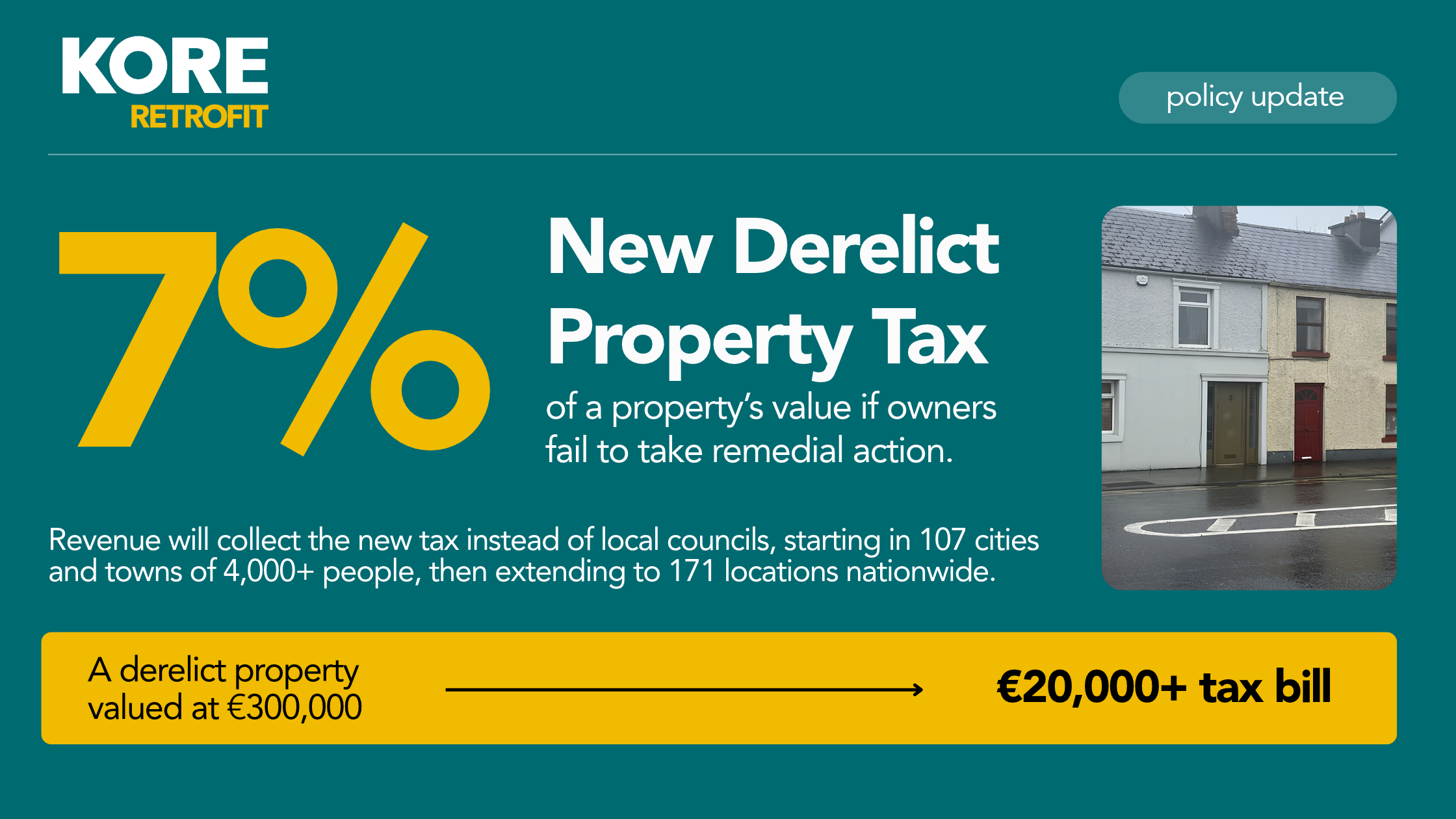
Owners of derelict buildings in 171 Irish towns and cities will soon pay a new tax of 7% of their property's value unless they bring it back into use by June 2028. At KORE Retrofit, we see this as an opportunity: the chance to turn empty, cold buildings into warm, energy-efficient homes, with SEAI grants to help along the way.
Bringing derelict homes back to life is one of the most practical things we can do for Ireland. It adds much-needed housing, makes better use of the buildings we already have, and lowers carbon in our towns and cities.
Here's what the new tax means for property owners, the dates to know, and how we can help you get ahead of it.
What's changing
The new tax replaces the old Derelict Sites Levy, which was run by local authorities and widely seen as ineffective. The rate stays at 7%, but Revenue will now administer and collect the charge.
The key changes, as reported by RTÉ News:
Mandatory registers. From January, every local authority will be legally required to compile a register of derelict buildings in its area and pass it to Revenue.
Revenue enforcement. Revenue, not the council, will chase payment. That is a significant step up in collection power.
Phase one: 107 towns and cities. The tax first applies in urban areas with 4,000+ people, including Dublin, Cork, Limerick and Galway cities, and towns such as Drogheda, Dundalk, Navan, Sligo and Roscommon.
Phase two: 64 more towns. A later phase extends it to towns with 2,000+ people, bringing the total to 171 locations.
Appeals. Owners will be able to appeal, with appeals officers based in local authorities.
The Government says the tax is mainly about "behavioural change": the aim is to get buildings fixed, not to collect money. Owners who act in time won't pay at all, and that's a goal we share.
Key dates for property owners
The tax comes into law in the new year, but no one will pay before mid-2028. That gap is your window to act.
January 2027: Local authorities become legally obliged to start compiling derelict property registers.
By September 2027: Preliminary derelict site registers are published nationwide. If your property is on one, you'll know.
June 2028: Deadline to carry out remedial work. Properties still derelict after this face the 7% charge from Revenue.
Upgrading a derelict property takes time, from the first survey through SEAI grant approval to the finished home. Owners who wait until their property appears on a register in late 2027 will all be looking for contractors at once. Our advice: take the first step now.
What it could cost you
A derelict property valued at €300,000 would face a tax bill of €21,000 under the 7% rate. That's money spent on a building that is still sitting empty.
| Property value | Annual tax at 7% |
|---|---|
| €150,000 | €10,500 |
| €200,000 | €14,000 |
| €300,000 | €21,000 |
| €400,000 | €28,000 |
Figures are illustrative, based on the 7% rate confirmed in the Finance Bill.
Now imagine putting that money into the building instead. A home energy upgrade raises the property's value, improves its SEAI Building Energy Rating (BER), and makes it a place someone wants to live.
From derelict to a warm, efficient home
Derelict and long-vacant buildings are often the coldest and least efficient in any town. That's why we start with the building itself: insulating the walls, attic and floors to keep the heat in, then upgrading heating and ventilation so the whole home works together.
Every derelict home we upgrade delivers on several fronts at once:
Off the register: a home back in use before June 2028 means no 7% tax.
More value: a better BER makes the property more attractive to buyers, tenants and lenders.
Lower bills, more comfort: warmer rooms that cost less to heat, for whoever lives there.
Lower emissions: less energy used means less carbon released, and more homes for Ireland's towns.
Grant support is available
You don't have to fund the work alone. Depending on the property and your circumstances, you may be eligible for:
Vacant Property Refurbishment Grant (Croí Cónaithe): aimed specifically at bringing vacant and derelict homes back into use, with a higher rate for derelict properties.
SEAI home energy grants: for upgrades such as wall and attic insulation, or a whole-home upgrade through an SEAI One Stop Shop. We'll help you work out which grants apply to your property.
Grant rates and rules change, so check the latest terms with your local authority and SEAI before you start. Some schemes require approval before work begins.
How KORE Retrofit can help
As Ireland's first registered SEAI One Stop Shop provider, KORE Retrofit has supported thousands of households on their journey to a more energy-efficient home. We guide owners through the whole upgrade, from survey and grants to the finished job, so getting it done is simpler.
If you own a derelict or vacant property, now is a good time to take the first step. Starting early means you can:
Get a survey and a clear scope of works before demand spikes in 2027.
Line up grant applications in the right order.
Complete the work comfortably ahead of June 2028.
Own a derelict or vacant property in one of the 171 towns and cities affected? Get in touch with KORE Retrofit to find out how a home energy upgrade could bring it back to life before the tax applies.
Source: RTÉ News, 19 October 2026. Details of the tax will be confirmed in the Finance Bill and may change as it passes through the Oireachtas.